Most people end the day wondering if they drank enough water — and most of them didn’t.
Without a tracking system, it’s nearly impossible to know whether you’ve hit your daily hydration goal. Thirst kicks in only after you’re already mildly dehydrated, making it a notoriously unreliable signal. You can feel fine in the morning and spend the afternoon fighting headaches and brain fog without ever connecting the dots.
In this guide, you’ll learn exactly how to track your daily water intake — from choosing the right method to building a habit that genuinely sticks — so you can stop guessing and start seeing real results.
Quick answer: To track your daily water intake, choose one method — a dedicated app, a time-marked water bottle, or a simple tally in a notes app — set a daily goal based on your weight and activity level, and log each drink as it happens rather than at the end of the day. Consistency in logging, not perfection, is what drives lasting hydration habits.
Why Tracking Your Water Intake Actually Matters
Hydration is one of the most underestimated levers in daily health — and most people are pulling it in the wrong direction.
Thirst is a lagging indicator. By the time you feel thirsty, mild dehydration has already begun. That afternoon slump, that persistent headache, that inability to focus after lunch? These are often dehydration symptoms, not signs you need more coffee.
The numbers are striking. Up to three-quarters of Americans regularly consume well below nationally recommended fluid intake levels (Culligan Quench / UF Health). That’s not a fringe problem — it’s the default.
Research published in Frontiers in Nutrition found that hydration status fluctuates seasonally and that even subclinical mild hypohydration may contribute to long-term age-related health outcomes (Frontiers in Nutrition, 2024–2025 prospective cohort study). In other words, consistently falling short on water isn’t just uncomfortable — it compounds over time.
Tracking creates awareness that changes behavior. It’s the same reason calorie logging works: once you can see the data, you make different decisions. A daily water intake tracker turns an invisible habit into a visible one.
Step 1 — Calculate Your Personal Daily Water Goal
Before you track anything, you need a target. Generic advice like “drink eight glasses a day” is outdated and imprecise.
The National Academies of Sciences, Engineering, and Medicine recommend approximately 3.7 liters (15.5 cups) of total water per day for men and 2.7 liters (11.5 cups) for women — from all beverages and food combined (National Academies via Mayo Clinic). These are baseline figures for sedentary adults in temperate climates.
A more personalized starting point is the body-weight formula: drink 0.5 to 1 ounce of water per pound of body weight per day. A 160-pound person would aim for 80–160 oz (roughly 2.4–4.7 liters).
Adjust for your situation:
- Exercise: Add approximately 12 oz for every 30 minutes of physical activity
- Hot or humid climate: Increase your baseline by 10–20%
- Pregnancy or breastfeeding: Needs increase significantly — consult your doctor
- High-sodium or high-protein diet: Higher intake is generally recommended
One thing most people overlook: roughly 20% of daily water intake comes from food — particularly fruits, vegetables, soups, and yogurt. You don’t need to subtract this from your goal, but it’s worth knowing that eating a produce-rich diet gives you a natural head start.
Does Coffee or Tea Count?
Yes — with caveats. Current evidence shows that caffeinated beverages at moderate intake (up to 3–4 cups per day) do contribute to your total daily fluid intake. The old myth that caffeine dehydrates you has been largely debunked for normal consumption levels.
That said, coffee and tea should supplement water, not replace it. If you’re relying on lattes and black tea to hit your fluid goals, you’re also adding caffeine, sugar, and cream to the equation. Plain water remains your best primary source.
Step 2 — Choose the Right Way to Track Your Daily Water Intake
This is where most guides go wrong. They list every possible option without helping you pick the right one. The best way to track hydration is the method you’ll actually use consistently — and that depends on your lifestyle.
There are three main approaches:
| Method | Best For | Effort Level |
|---|---|---|
| Smartphone app | People who already track health metrics | Low–Medium |
| Time-marked water bottle | Visual learners, desk workers | Very Low |
| Manual logging | Beginners who want simplicity | Low |
Hydration Tracking Apps
Apps are the most feature-rich option. A good water intake tracking app lets you set a personalized daily goal, log each drink with a tap, and receive scheduled reminders throughout the day.
Current options worth considering in 2026:
- WaterMinder — clean interface, customizable reminders, syncs with Apple Health and Google Fit
- Hydro Coach — calculates your goal automatically based on weight and activity
- MyFitnessPal — ideal if you’re already logging food; water tracking is built in
Look for apps that sync with your existing health platform (Apple Health, Google Fit, or Fitbit). This lets your hydration data flow into a broader wellness picture without extra manual entry.
AI-powered hydration tools are also emerging. Apps like Lasta and newer iterations of Hydro Coach use machine learning to adjust your daily water goal dynamically based on your logged activity, sleep data, and even weather at your location. If you want a system that adapts to your life rather than giving you a fixed target, these are worth exploring.
Time-Marked and Smart Water Bottles
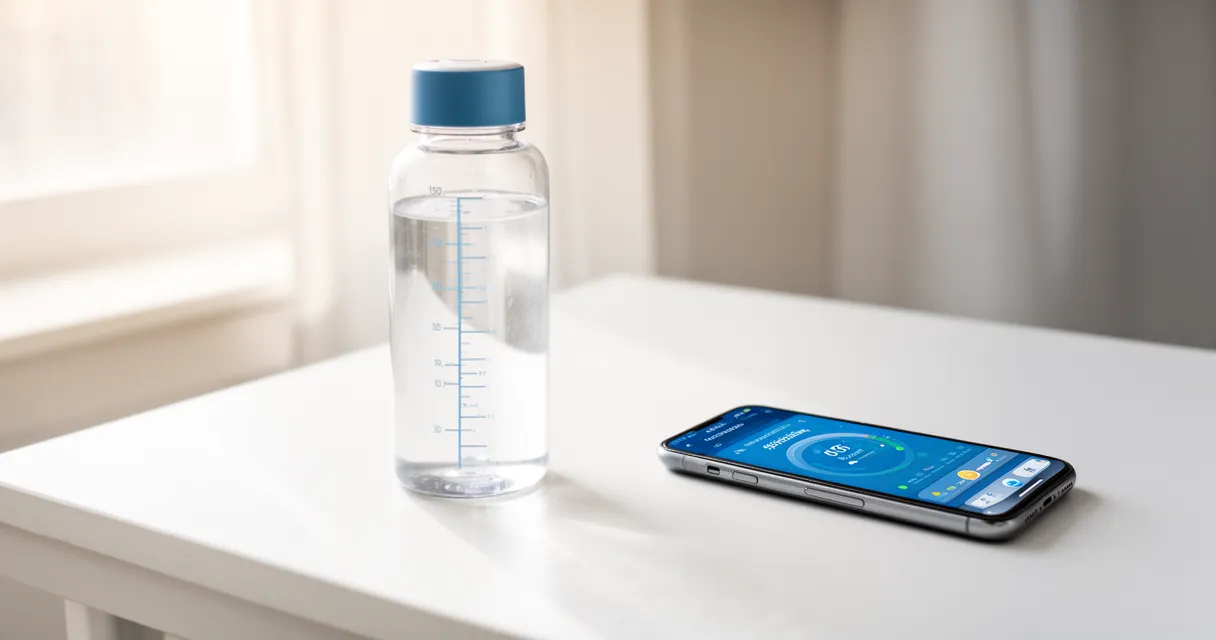
Time-marked bottles have hour-by-hour labels (e.g., “By 10 AM,” “By 12 PM”) printed directly on the bottle. You drink to the line, refill, and repeat. No phone required.
Smart bottles take this further — brands like HidrateSpark use LED glow reminders and sync with an app to log intake automatically when you drink. They’re excellent for people who want tracking without any manual logging.
Both options work especially well for desk workers who can keep a bottle in front of them all day. Visual, passive, and phone-free.
Manual Logging: Journals and Tally Methods
The simplest system: a sticky note on your desk with a tally mark for every glass you drink. Or a running note in your phone’s default notes app. Or a line in a bullet journal.
Manual logging works well if you’re new to tracking and want to build awareness before committing to an app. It’s low-friction and requires zero setup. The downside is that it offers no reminders and no trend data — but for a beginner, that’s often fine.
Step 3 — Set Up Your Tracking System in Under 5 Minutes
Decision fatigue kills habit formation. The goal here is to set up your chosen system right now, not later.
If you’re using an app:
- Download your chosen app and open it immediately
- Enter your weight, activity level, and wake/sleep times
- Let it generate a personalized schedule
- Enable push notifications — this single step is the number-one predictor of consistent logging
If you’re using a time-marked bottle:
- Fill your bottle to capacity first thing in the morning
- Note your bottle’s capacity (usually printed on the bottom)
- Stick a small note next to your workstation with your refill target and times
- Set one mid-morning and one mid-afternoon phone alarm as backup reminders
If you’re using manual logging:
- Put a sticky note and pen on your desk — or open a persistent note in your phone
- Draw five tally marks as a visual target for your first five glasses
- Set three phone alarms: 10 AM, 1 PM, and 4 PM as drinking reminders
The setup should take under five minutes. If it’s taking longer, you’re overcomplicating it. A simpler system you actually use beats a sophisticated one you abandon by Thursday.
Step 4 — Build a Habit That Sticks
Tracking tools only work if you use them consistently. Here’s how to make hydration automatic rather than effortful.
Anchor drinking to existing habits. This technique — called habit stacking — pairs a new behavior with something you already do every day:
- One glass when you wake up, before anything else
- One glass with breakfast, lunch, and dinner
- One glass before bed
That’s five guaranteed glasses before you’ve even thought about it.
Use implementation intentions. Instead of “I’ll drink more water,” decide: “When I sit down at my desk in the morning, I will fill my water bottle before opening my laptop.” Specific triggers create automatic responses.
Only drink from measured containers. It’s surprisingly easy to underestimate how much you’ve consumed. A standard mug, a large tumbler, and a restaurant glass can all hold wildly different volumes. Measured bottles and glasses eliminate the guesswork.
Review your data weekly. After one week of tracking, look for patterns. Are you always falling short on Fridays? Do you consistently drop off after 3 PM? Weekly reviews reveal exactly where your system needs reinforcement — something you can never see if you’re not tracking.
For competitive personalities, gamified apps that track daily streaks can be surprisingly effective. Hitting a 14-day streak creates real motivation to not break the chain.
Signs You Are Not Drinking Enough Water
Even with a tracking system in place, it helps to know what under-hydration looks like in real time. These signs you are not drinking enough water are your body’s feedback loop.
Early warning signs:
- Dark yellow or amber urine — the most reliable at-home indicator. Pale yellow or near-clear means well-hydrated. Dark means drink now.
- Persistent headaches — especially in the afternoon
- Difficulty concentrating or mental fog
- Afternoon energy crashes that coffee doesn’t fix
Moderate dehydration signs:
- Dry mouth or chapped lips
- Decreased urination frequency (less than 4–6 times per day)
- Feeling consistently tired despite adequate sleep
The urine color test costs nothing and requires no app. Make it a daily habit, and pair it with your tracking data for a complete picture.
Tracking these symptoms alongside your water log over time reveals your personal patterns — which days, activities, or conditions consistently lead to poor hydration. That’s information no single data point can give you.
How a Health Tracker Can Upgrade Your Hydration Habits
Once water tracking feels automatic, the next level is understanding what your hydration data actually means in context.
A standalone water app tells you one thing: how many ounces you drank today. But it can’t tell you why you slept poorly last Tuesday, or why your workout on Wednesday felt sluggish. For that, you need to see hydration alongside your other health metrics.
Logging water inside a broader health dashboard lets you correlate intake with energy levels, sleep quality, workout performance, and even symptom frequency. When you see that your worst sleep nights reliably follow your lowest-hydration days, that insight changes your behavior far more effectively than a reminder notification.
This kind of cross-metric pattern spotting is where AI tools are genuinely useful. Platforms that use machine learning to surface correlations across your logged data — connecting hydration to sleep quality or activity levels — can surface insights you’d never notice manually. Instead of staring at raw numbers, you get actionable signals: “Your energy score was 22% lower on days when you drank under 60 oz.”
Check out our complete health tracking guide for a full breakdown of which metrics to track together, and how to track your daily health metrics in a way that creates genuine insight rather than data overload.
Start logging your water intake alongside your other daily health metrics — see how hydration affects your energy and sleep in one dashboard. That’s the difference between knowing your numbers and actually understanding your health.
Frequently Asked Questions
How much water should I drink each day?
The National Academies of Sciences, Engineering, and Medicine recommend approximately 3.7 liters (15.5 cups) for men and 2.7 liters (11.5 cups) for women daily — including water from all beverages and food sources. A practical alternative: drink 0.5 to 1 ounce per pound of body weight. These are baselines — your actual needs vary with activity level, climate, and health status.
What is the best app for tracking water intake?
There’s no single best app — the right choice depends on what you already use. If you track nutrition, MyFitnessPal integrates water logging seamlessly. For simplicity, WaterMinder is well-designed and syncs with Apple Health and Google Fit. If you want goal personalization, Hydro Coach calculates your intake based on your body and activity. For the broadest view of your health, consider an all-in-one health tracking platform that shows hydration alongside sleep, activity, and symptoms.
How do I know if I am drinking enough water throughout the day?
The easiest real-time check is urine color — pale yellow means you’re well-hydrated, dark yellow or amber means drink more immediately. Supplement this with symptom awareness: persistent headaches, afternoon energy dips, and difficulty concentrating are early dehydration signals. A time-marked bottle or a tracking app provides ongoing feedback so you don’t have to wait for symptoms to appear.
Does coffee or tea count toward my daily water intake?
Yes. Current evidence shows that caffeinated beverages at moderate intake contribute meaningfully to daily fluid totals. The old dehydration myth has been largely debunked for normal consumption. However, coffee and tea should complement water, not replace it — and adding sugar or cream reduces their net hydration benefit. Use them as a supplement, not your primary hydration strategy.
How can I build a consistent habit of drinking water every day?
Use habit stacking — anchor water drinking to things you already do (waking up, meals, sitting at your desk). Set implementation intentions with specific triggers rather than vague goals. Keep a filled, measured water bottle visible at all times. Review your tracking data weekly to spot patterns and fix gaps. If you’re motivated by streaks, a gamified tracking app can make consistency feel rewarding rather than effortful.
Conclusion
Staying hydrated isn’t complicated — but knowing how to track your daily water intake requires a system. Here’s what this guide covered:
- Calculate your personal goal first — the 8-glasses rule is a starting point, not a prescription
- Choose the method that matches your life, not the most popular one
- Log in real time, not at the end of the day — retrospective logging is inaccurate and discouraging
- Watch for dehydration signs like urine color and afternoon fatigue as your real-time feedback loop
- Connect hydration to your other health data to uncover patterns that single-metric tracking will never reveal
Avoid the common health tracking mistakes that derail most people early on, and consider keeping a symptom diary alongside your water log to connect the dots between hydration and how you actually feel.
Pick one tracking method from this guide and set it up today. Once logging water feels automatic, bring your hydration data into a broader health tracking system — and start seeing how it connects to your sleep, energy, and fitness performance. That’s when tracking stops being a chore and starts being genuinely useful.