You tracked every meal perfectly all week — then Friday night dinner undid it all because you had no idea what was in your pasta.
It happens to almost everyone. According to a 2025 YouGov report, 3 in 10 Americans dine out at least once a week, and more than half of those eat out 2–3 times weekly. That’s a lot of meals where you’re flying blind on calories.
Restaurant meals are the most common breakdown point for anyone trying to figure out how to count calories when eating out. There’s no nutrition label, portions are enormous, and hidden oils and sauces add up fast. Social pressure to “just enjoy yourself” doesn’t help either.
This guide gives you a practical, repeatable system — whether you’re at a chain restaurant, a local bistro, or a fast food drive-through. No perfection required.
Quick answer: Research the menu online before you go, use chain restaurant data as a calorie benchmark when nutrition info isn’t available, estimate portions using hand-size references, and log the meal in a calorie tracking app immediately. Erring slightly high is always better than skipping the entry entirely.
For the full framework, check out our nutrition and diet planning guide.
Why Restaurant Calories Are Notoriously Hard to Count When Eating Out
Before diving into strategies, it helps to understand why restaurant calorie counting is genuinely difficult — not because you’re doing it wrong, but because the system is stacked against you.
Restaurant portions routinely exceed government serving size recommendations by 2–5x. A pasta dish at a mid-range restaurant often contains two to three servings by standard nutrition definitions, but it arrives on one plate and most people eat it all.
Here’s what makes it worse: even when calorie counts are posted, they’re not always accurate. A 2020 study published in PMC/NCBI tested chain restaurant items and found that 19% had at least 100 more calories than their stated menu count. Some were off by far more.
Hidden calories compound the problem. Restaurants use far more cooking oil than home cooks — a single sauté can mean an extra 200–300 calories you never see listed. Butter-finishing on steaks and vegetables, sugary glazes, and calorie-dense garnishes all add up without showing up in the dish description.
The 20% Rule: Why You Should Always Log a Little High
Even FDA-regulated nutrition labels on packaged foods carry a 20% legal margin of error. Restaurant estimates have no such regulation at all.
This means that if you log a restaurant meal at exactly what it claims, you may be systematically under-counting over time. The practical fix: round up by 10–20% when logging any restaurant meal. This small buffer protects your weekly calorie accuracy and prevents that frustrating plateau where you’re “doing everything right” but not seeing results.
Step 1: Do Your Menu Research Before You Arrive
The single most effective thing you can do for tracking calories at restaurants happens before you even get there.
Most major chains post full nutrition data on their website or app. A 5-minute menu check before you leave home can turn a stressful guessing game into a confident, pre-logged meal.
Here’s the exact process:
- Search the restaurant name + “nutrition” or “calories” — most chain sites have a dedicated nutrition calculator
- Log your planned meal in your calorie tracker before leaving home — this mentally locks in your choice before you’re at the table under social pressure
- Google “[restaurant name] menu calories” for independent restaurants — crowd-sourced food databases often have entries for popular local spots
- Identify 2–3 options that fit your calorie budget so you’re choosing between good options, not scrambling at the last minute
Pre-planning removes the biggest obstacle: decision fatigue at the table. When the bread basket arrives and the server is hovering, you’ve already decided.
Step 2: Decode the Menu — Words That Signal High-Calorie Dishes
When you can’t find nutrition data ahead of time, the menu itself contains clues. Learning to read them is a core restaurant calorie counting tip that pays off for life.
High-calorie red flags on any menu:
- Crispy, battered, breaded, fried
- Creamy, smothered, loaded, stuffed
- Glazed, candied, au gratin, alfredo
- Pan-fried, sautéed in butter
Lower-calorie signals:
- Grilled, steamed, broiled, roasted
- Poached, baked, fresh, light
A “crispy chicken sandwich” versus a “grilled chicken sandwich” can easily be a 300–400 calorie difference. That single word swap matters.
Appetizers deserve special attention. A 2014 PMC review of 30,923 menu items across 245+ chain restaurants found that appetizers average 813 calories — more than most entrées. If you order an appetizer, treat it as a full meal in your tracking, not an add-on.
How to Spot Hidden Calories in Restaurant Dishes
The most calorie-dense ingredients are often invisible. To spot hidden calories in restaurant dishes, watch for:
- Cooking oil: Restaurants add 1–3 tablespoons of oil per cooked item as standard practice. That’s 120–360 calories before the food hits your plate.
- Butter finishing: Many restaurants brush steaks, fish, and vegetables with butter right before serving for shine and flavor.
- Sauces and dressings: A Caesar dressing can add 200–300 calories. Always ask for sauces and dressings on the side so you control the amount.
- Calorie-dense toppings: Cheese, nuts, croutons, bacon bits, and avocado all add 50–150 calories per tablespoon-size serving.
The safest habit: assume any restaurant dish has 100–200 more calories than you’d guess from the description alone.
Step 3: Estimate Portions When There Is No Nutrition Data
Estimating restaurant calories without any data is a skill — and like all skills, it gets better with practice. Here’s the framework professionals use:
Hand-based portion references (always with you, always to scale):
| Body part | Portion equivalent | Common food examples |
|---|---|---|
| Palm (3 oz) | 1 serving of protein | Chicken breast, fish fillet |
| Fist (1 cup) | 1 serving of carbs | Rice, pasta, potatoes |
| Cupped hand (½ cup) | 1 serving of fruit or oatmeal | Berries, cooked grains |
| Thumb (1 tbsp) | 1 serving of fat | Oil, nut butter, dressing |
The Proxy Technique is your backup when you’re at an independent restaurant with zero data. Find the most similar dish at a comparable chain (Cheesecake Factory, Applebee’s, TGI Fridays) and use that calorie count as a high-end benchmark. An independent burger and fries isn’t going to be mysteriously fewer calories than the same meal at Red Robin.
Two more rules of thumb for estimation:
- Add 120 calories (1 tbsp oil) per cooked protein or vegetable item to account for kitchen cooking fat
- If the plate looks like two servings, log it as two — restaurant portions routinely are
Building Your Calorie Estimation Eye at Home
The best way to get accurate at estimating portions at restaurants is to practice at home with a food scale. When you weigh 4 oz of chicken breast regularly, you build a mental image of what it looks like on a plate. Over time, your eye gets reliable enough that your restaurant estimates are within 10–15% of reality.
For a full walkthrough, read our guide on how to track calories accurately.
Step 4: Use a Calorie Counter App to Count Calories When Eating Out
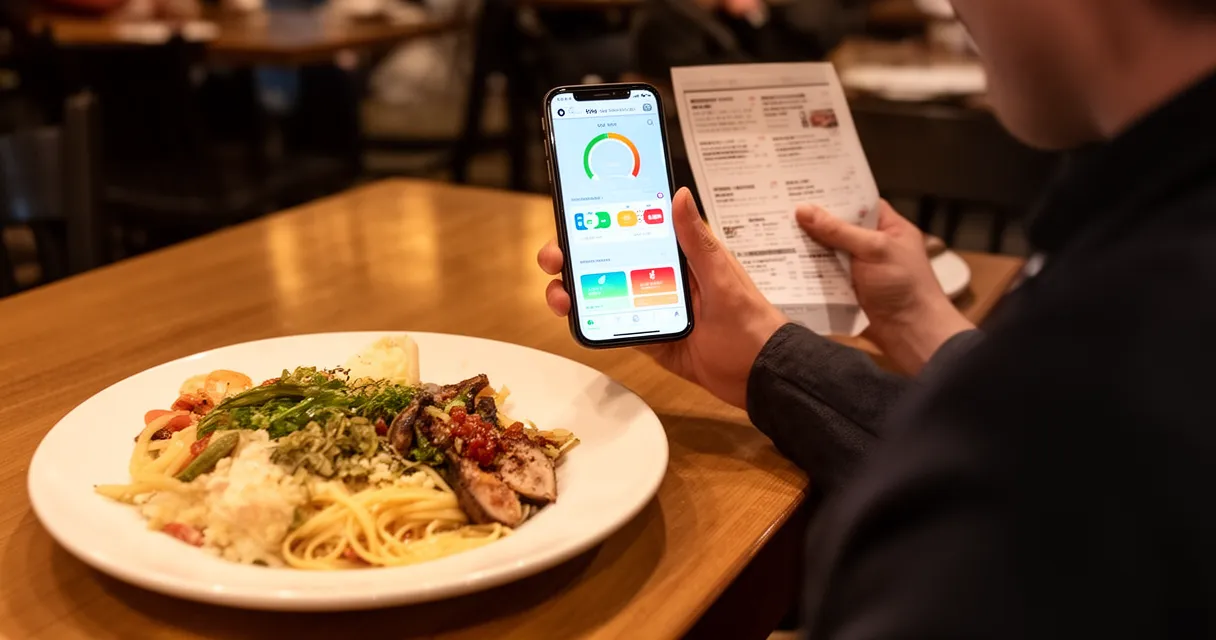
This is where all the estimation work above becomes a real, logged entry. A calorie tracking app for dining out is the bridge between your best estimate and a number you can actually use.
Modern calorie counter apps like MyFitnessPal, Cronometer, and Lose It! include searchable restaurant databases covering thousands of chains and independent locations. Many entries are user-verified, which means popular local restaurants often already have crowd-sourced data.
The workflow at the restaurant:
- Open the app while you’re still at the table (or in the car immediately after)
- Search by restaurant name and dish title
- If an exact match exists, add it — adjust serving size if your portion looked larger than standard
- If no entry exists, use the custom meal builder to enter your hand-based estimate rather than leaving the entry blank
- Add 10–20% as a buffer using the 20% rule
Log while the meal is still fresh. Memory for food quantities degrades fast — studies on dietary recall show significant underestimation when logging is delayed even a few hours.
Key takeaway: An imperfect logged entry is infinitely more useful than no entry. A rough estimate keeps your running total meaningful. Skipping the entry entirely breaks your tracking streak and makes the whole day harder to assess.
Try searching your go-to restaurant in your calorie counter app before your next meal out — you may find the dish is already logged and ready to add.
How AI Is Transforming Restaurant Calorie Tracking
AI-powered features are rapidly changing what calorie counter apps can do — and they’re especially useful when eating out.
Several apps now include AI food photo recognition: take a photo of your plate and the model estimates the meal’s calorie and macro content automatically. Platforms like Noom and Lose It! have integrated vision-based AI that can identify dishes, estimate portion sizes, and generate a calorie estimate in seconds — no manual searching required.
AI-powered tools worth knowing about for restaurant tracking:
- Lose It! Snap It feature — uses computer vision to identify foods from photos and auto-log them
- ChatGPT or Claude — describe your meal in plain language (“I had a pasta dish that looked like 2 cups with a creamy sauce and chicken”) and ask for a calorie estimate; useful when no app database entry exists
- MyFitnessPal’s AI meal scan — photo-based food logging that pulls from their extensive database
- Calorie Mama / FoodAI — standalone AI food recognition APIs used in several nutrition apps
These tools aren’t perfect, and the 20% rule still applies to AI estimates. But for the 5-second log at the restaurant table, AI photo recognition removes the biggest friction point: having to manually search and identify every component.
How to Count Calories at Fast Food Restaurants
Fast food is actually the easiest scenario for calorie tracking for dining out — and most people don’t take advantage of it.
Chain fast food restaurants in the U.S. are legally required to display calorie counts on menus. The numbers are right there. Use them.
The problem is that most people don’t look. According to the USDA Economic Research Service (August 2024), only about half of U.S. adults report noticing posted calorie counts on restaurant menus. Making it a conscious habit takes 30 seconds and can save hundreds of calories per meal.
Fast food calorie traps to watch for:
- Combo sides and drinks — a medium combo meal can add 600+ calories beyond the sandwich alone (medium fries: ~320 cal; medium soda: ~200 cal)
- Build-your-own items — burritos, subs, and bowls can double in calories based on what you add; log these component by component in your app
- “Value” sizing — upsizing fries and drinks is typically an extra 200–400 calories for pennies
Smarter Fast Food Swaps That Save Hundreds of Calories
| Instead of… | Try… | Approximate savings |
|---|---|---|
| Medium fries | Side salad (no croutons, dressing on side) | ~250–300 cal |
| Crispy chicken sandwich | Grilled chicken sandwich | ~150–200 cal |
| Medium soda | Water or unsweetened iced tea | ~180–200 cal |
| Regular burger sauce | Mustard or ketchup only | ~100–150 cal |
| Creamy dipping sauce | Salsa or hot sauce | ~100–200 cal |
These swaps don’t require willpower — they’re just information. Once you know that swapping to a grilled sandwich and water saves 350+ calories, the choice becomes obvious.
Strategies for Eating Out Frequently Without Derailing Progress
How to stay on track with calories when eating out regularly isn’t about restriction — it’s about building flexible habits that absorb restaurant meals without breaking your progress. To verify those habits are actually working, run your numbers through a free body fat calculator every few weeks — body fat percentage and waist-hip ratio reveal trends that the scale alone often hides.
The dining-out calorie budget: On days you plan to eat out, eat lighter at breakfast and lunch. Bank 300–500 calories earlier in the day so you have room at dinner without going over your daily target.
The 80/20 approach: Track with precision 80% of the time. For the other 20% — social dinners, celebrations, meals at restaurants with zero data — make your best estimate and move on. Consistent imperfect tracking beats perfect tracking that collapses under social pressure.
Ask for modifications without guilt. Dressing on the side, no croutons, extra vegetables instead of fries, sauce on the side — kitchens handle these requests constantly. You’re not being difficult; you’re being a regular customer.
Box half before you eat. Studies show 67% of diners finish their entire entrée. Ask for a to-go box when your food arrives and set aside half the meal immediately. You’ll eat a restaurant-appropriate portion and have lunch for tomorrow.
Avoiding common mistakes when reading nutrition information also helps — the same misreading habits that trip people up on labels show up when interpreting posted menu counts too.
Frequently Asked Questions
How accurate are restaurant calorie counts on menus?
Less accurate than most people assume. A 2020 study in PMC/NCBI found that 19% of tested chain restaurant items had at least 100 more calories than listed. FDA regulations allow a 20% margin of error even for packaged foods — restaurant menu counts have no such regulatory requirement. Treat posted counts as directional estimates, not precise figures, and log slightly high as a buffer.
What should you do when a restaurant doesn’t provide nutrition information?
Use the Proxy Technique: find the most similar dish at a comparable chain restaurant and use that calorie count as a high-end benchmark. Search the dish in a calorie counter app’s food database — crowd-sourced entries often exist for popular local spots. Add an extra 100–200 calories to your estimate to account for cooking oils and sauces. Log an estimate rather than nothing — a rough number is better for tracking consistency than a blank entry.
How do you count calories at fast food restaurants?
Chain fast food restaurants in the U.S. must display calorie counts by law. Use the posted numbers — they’re relatively reliable compared to sit-down restaurants. Log the meal in your calorie counter app by searching the chain name and item. Pay close attention to combo sides and drinks, which can double or triple the calories of the main item.
What cooking methods and menu words signal higher-calorie dishes?
High-calorie keywords: crispy, battered, creamy, smothered, loaded, glazed, pan-fried, au gratin, alfredo. Lower-calorie keywords: grilled, steamed, broiled, roasted, poached. Sauces and dressings always add significant calories — always ask for them on the side so you control how much you consume.
Is it worth counting calories if you eat out regularly?
Yes — imperfect tracking is far more useful than no tracking. An estimated log entry keeps your running total meaningful and maintains the tracking habit. Research consistently shows that people who log consistently, even imperfectly, make better overall dietary choices. The goal isn’t laboratory precision; it’s sustained awareness.
Measure the results, not just the meals: Once your restaurant-tracking system is humming, drop your stats into our free body composition calculator to confirm BMI, body fat percentage, and lean mass are moving in the right direction.
Conclusion
How to count calories when eating out doesn’t require perfection — it requires a repeatable system.
Here’s the one to use: research before you go, decode the menu when you arrive, estimate portions using hand references when data is missing, and log the meal immediately in a calorie counter app.
Use published chain data and the Proxy Technique to anchor estimates when exact nutrition info isn’t available. Err on the side of logging slightly high, and build a flexible calorie budget on days you plan to eat out.
The technology has never been better. AI food recognition can log a restaurant meal from a photo in seconds. App databases cover thousands of restaurants with crowd-sourced data. ChatGPT or Claude can estimate calories from a plain-language meal description when nothing else works.
You don’t have to choose between enjoying meals out and staying on track. You just need a system.
Download a calorie counter app and search your favorite restaurant before your next meal out — you might be surprised how many dishes are already in the database and ready to log.