Nearly 80% of people abandon their health goals by February — not because they lack willpower, but because their goals were never built to last. You set an ambitious target, feel motivated for a few weeks, then life gets busy and the goal quietly disappears.
If that sounds familiar, you’re not alone. 56% of US adults — roughly 151 million people — plan to set personal health or fitness goals in 2026 (Health & Fitness Association, 2026). Most of them will struggle, not because health improvement is impossible, but because the goal itself was flawed from day one.
In this guide, you’ll learn exactly how to set realistic health goals using a proven framework, see real examples built for beginners, and get a practical system for tracking your progress so you stay on track all year long.
Quick answer: To set realistic health goals, make them SMART — Specific, Measurable, Achievable, Relevant, and Time-bound. Start with one or two goals, write them down, and review your progress weekly to stay accountable.
Try our free Body Composition Calculator — get your BMI, body fat percentage, waist-hip ratio, and lean mass in seconds.
Why Most Health Goals Fail Before February
The failure rate isn’t random. Nearly 80% of people quit their health and fitness goals by February (Health & Fitness Association / Pura Vida Fitness, 2026), and the reasons cluster around the same patterns every year.
The most common culprits:
- Goals are too vague. “Get healthier” or “exercise more” gives you nothing concrete to do tomorrow morning.
- Goals are too drastic. Going from no exercise to daily 5 AM workouts is a recipe for burnout inside two weeks.
- There’s no tracking system. Without a way to measure progress, you lose momentum the moment motivation dips.
There’s also a deeper issue: most people set goals emotionally rather than strategically. You feel inspired on January 1st and write down the version of yourself you want to be — without a plan for who you actually are right now.
Strategic goal-setting flips this. You start from your real baseline, not your aspirational one, and build from there.
What Makes a Health Goal Realistic?
“Realistic” doesn’t mean easy. It means achievable given your actual life — your current schedule, energy level, health status, and resources.
A realistic health goal meets three criteria:
- It fits your existing schedule without requiring a complete lifestyle overhaul.
- It matches your current fitness or health level, not someone else’s.
- It has a clear, measurable success condition you can check weekly.
The biggest trap is copying goals from social media or friends. Someone else’s “easy” goal may be completely unrealistic for you — and that’s fine. What matters is that your goal connects to your baseline.
Starting Where You Are, Not Where You Want to Be
Before writing any goal, assess your starting point honestly. If you currently don’t exercise at all, a 20-minute walk three times a week is genuinely ambitious. Running 5 miles every day is not a goal — it’s a fantasy.
Ask yourself:
- What am I actually doing right now in this area?
- What would be a meaningful but achievable step up from that?
- Can I sustain this if I’m tired, stressed, or traveling?
If the answer to the last question is “probably not,” scale it back. You can always raise the bar once you’ve built the habit.
How to Use the SMART Framework for Health Goals
The SMART framework is the most widely used goal-setting system in healthcare — and for good reason. Research shows that 65.5% of patients adhered to SMART goals created during community health counseling sessions (Thoroughcare / PMC Community Health Counseling Research), compared to far lower rates for vague goals.
SMART stands for:
- Specific — What exactly will you do? (“Eat vegetables with dinner 5 nights a week” beats “eat healthier.”)
- Measurable — How will you know you succeeded? Use numbers, frequency, or duration.
- Achievable — Is this realistic given your current schedule and energy levels?
- Relevant — Does this goal connect to a health priority that genuinely matters to you?
- Time-bound — Set a 30-, 60-, or 90-day deadline so you have a clear endpoint.
Every letter matters. A goal that’s specific but not measurable still leaves you guessing. A goal that’s measurable but not achievable still leads to burnout.
Turning a Vague Goal into a SMART Goal: Step-by-Step Example
Let’s transform a common vague goal into a SMART one:
Before: “I want to get healthier.”
After (SMART version):
- Specific: Walk briskly for 25 minutes after dinner.
- Measurable: 4 times per week, logged in my phone.
- Achievable: Yes — I have 30 minutes free most evenings.
- Relevant: My doctor recommended more daily movement for blood pressure.
- Time-bound: I’ll maintain this for 8 weeks, then reassess.
Final SMART goal: “I will walk briskly for 25 minutes after dinner, 4 evenings per week, for the next 8 weeks, and log each walk in my habit tracker.”
That one sentence answers what, how much, how often, why, and when. That’s a goal you can actually act on.
SMART Health Goals Examples for Beginners
Here are six SMART health goals examples across key categories that you can copy and adapt. Each one is designed to be genuinely achievable if you’re just starting out.
Physical Activity Goals
| Vague Goal | SMART Version |
|---|---|
| Exercise more | Walk 8,000 steps per day, 5 days a week, for 6 weeks |
| Get stronger | Complete two 20-minute bodyweight workouts per week for the next 30 days |
| Move around more at work | Stand up and stretch for 5 minutes every 90 minutes during the workday |
Starting with consistent, lower-intensity movement builds the habit foundation. Once walking 8,000 steps feels automatic, increasing to running or strength work becomes a much smaller lift. For more on measuring your movement, see our guide on how to track your daily health metrics.
Nutrition and Hydration Goals
| Vague Goal | SMART Version |
|---|---|
| Eat healthier | Add one vegetable serving to dinner 5 nights per week for the next 30 days |
| Drink more water | Drink 8 glasses (64 oz) of water per day, every day for 4 weeks |
| Cut back on sugar | Replace my afternoon soda with sparkling water 5 days per week for 6 weeks |
Nutrition goals work best when they add rather than remove. “Add a vegetable” is easier to sustain than “stop eating junk food.” For practical strategies on hitting your hydration targets, our guide to tracking your daily water intake has you covered.
Sleep and Mental Wellness Goals
Not all health and wellness goals have to be about steps or salads. Setting achievable health goals around behavior is just as valid — and often more impactful.
| Vague Goal | SMART Version |
|---|---|
| Sleep better | Be in bed by 10:30 PM on weeknights, 5 out of 7 nights, for 30 days |
| Reduce stress | Practice 10 minutes of deep breathing or meditation every morning for 4 weeks |
| Be more consistent with healthcare | Schedule and attend 2 preventive health appointments in the next 90 days |
Sleep and mental wellness goals frequently get overlooked because they’re harder to quantify — but they’re deeply connected to every other health goal you set.
How to Track Progress Toward Your Health Goals
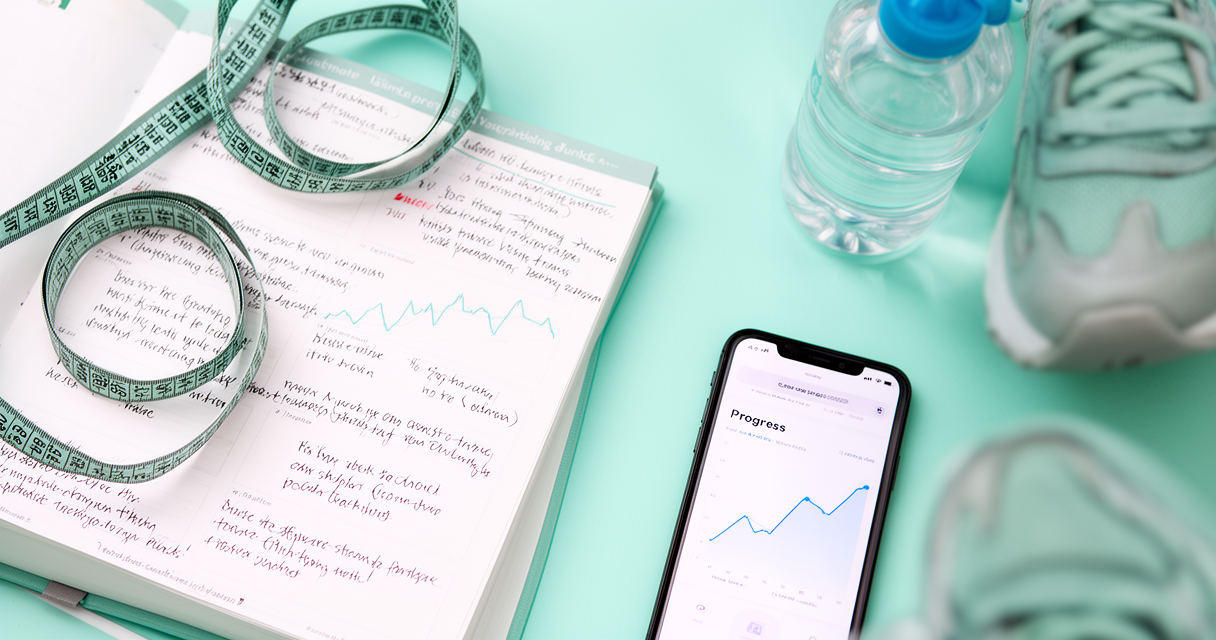
Tracking is what separates goal-setters from goal-achievers. A goal without a tracking system is just a hope.
The most effective approach tracks two things simultaneously:
- Behaviors — Did I do what I said I’d do? (Did I walk today? Did I drink 8 glasses of water?)
- Outcomes — What result is accumulating? (Steps logged, weight, sleep hours, energy level)
Behavior tracking is more sustainable because it keeps you focused on what you can control. Outcome tracking keeps you honest about whether your behaviors are producing results. You need both.
Common tracking methods:
- Paper habit tracker — Simple, no technology required, surprisingly effective
- Habit tracker app — Streaks, reminders, and visual progress dashboards
- Spreadsheet — Flexible and easy to customize for multiple goals
- Wearable device — Automatic logging for steps, sleep, heart rate
Choosing the Right Tracking Method — Including AI-Powered Tools
Your best tracking method is the one you’ll actually use consistently. But modern technology has made tracking significantly more powerful — and more personalized.
AI-powered health tools have transformed how people manage their fitness goals. Apps like Whoop and Oura Ring use machine learning to analyze your sleep, recovery, and strain data, then give you personalized readiness scores and goal recommendations tailored to your body’s patterns — not a generic average.
ChatGPT and Claude (Anthropic’s AI assistant) can serve as on-demand health goal coaches. You can describe your current situation and ask for a SMART goal draft, a weekly check-in structure, or help troubleshooting why a goal isn’t sticking. AI assistants won’t replace your doctor, but they’re remarkably useful for thinking through goal structure and accountability plans.
Platforms like MyFitnessPal and Cronometer now use AI to analyze your nutritional patterns and flag gaps — useful if you’re working on nutrition goals without a dietitian. And Apple Health’s AI-powered insights surface trends in your data you’d never notice on your own.
For a full breakdown of tools and methods, see our complete health tracking guide.
Start tracking your health goals today — see your progress in real time and stay accountable every day.
How Often Should You Review and Adjust Your Health Goals?
Setting goals is a one-time event. Staying on track requires a rhythm of regular reviews.
Weekly check-in (5 minutes):
- Did I complete my goal behaviors this week?
- What got in the way?
- What do I need to adjust for next week?
Monthly review (15–20 minutes):
- Is this goal too easy now? Raise the bar.
- Is it still too hard? Scale it back without guilt.
- Am I seeing any movement in outcomes?
Quarterly reset:
- Do my current goals still align with my health priorities?
- Have my circumstances changed enough to warrant new goals?
- What did I accomplish in the last 90 days that I can build on?
Here’s the mindset shift that makes this work: adjusting a goal is not failure. It’s self-awareness. Life changes — work stress, illness, travel, family demands — and your goals need to flex with it. Rigid goals that don’t bend eventually break. For tracking how your health shifts over time, keeping a symptom diary alongside your goal log adds useful context.
Frequently Asked Questions
What is a realistic health goal to set as a beginner?
Focus on one small, specific behavior change you can fit into your current routine without major disruption. Start simpler than you think you need to. If you’ve never exercised regularly, a 15-minute daily walk is a legitimate and powerful goal. Build the habit first — intensity can come later.
How do you use the SMART method to create health goals?
Run your goal through each letter: Is it Specific (clear action)? Measurable (trackable number or frequency)? Achievable (fits your actual schedule)? Relevant (connected to something that matters to you)? Time-bound (has a deadline)? For example: “Drink 8 glasses of water per day for the next 30 days” hits every letter.
How often should you review and update your health goals?
Do a brief weekly check-in (5 minutes) to review the past 7 days, a monthly review to adjust difficulty up or down, and a quarterly reset to realign goals with your current priorities. Update whenever a goal feels too easy, too hard, or no longer relevant to your life.
What are examples of measurable health goals?
- Walk 8,000–10,000 steps per day
- Sleep 7–8 hours per night
- Eat vegetables with every dinner
- Drink 8 glasses of water daily
- Complete two strength training sessions per week
Each of these has a number you can check at the end of each day or week.
How do you track progress toward your health goals over time?
Use a habit tracker app, paper journal, wearable device, or dedicated health app. Track both behaviors (what you did) and outcomes (steps, sleep hours, weight). Review your data weekly. AI-powered apps like Whoop or Oura can automate much of this and surface patterns you’d otherwise miss.
Conclusion
Knowing how to set realistic health goals isn’t about lowering your ambitions — it’s about building a path you can actually walk.
Here’s what you now know:
- Realistic health goals are specific, measurable, and matched to your current life — not someone else’s ideal version of what health looks like.
- The SMART framework gives you a proven structure for writing goals that stick and a 65.5% higher chance of following through.
- Tracking progress converts a goal from a wish into a measurable result — and modern AI tools make that easier than ever.
Pick one health goal from this guide. Write it in SMART format. Start tracking it today.
Small, consistent steps compound into lasting change — and it all starts with one goal that was actually built to last.