A solo dentist scrolling through Overjet’s site sees “FDA-cleared.” Same on Pearl’s site. Same on VideaHealth’s. All three also promise higher case acceptance and more revenue per patient, without publishing a price anywhere a buyer can actually see it.
That combination — real regulatory clearance stacked next to unverifiable revenue math — is exactly where independent practice owners get burned. A 1-2 doctor office doesn’t have a DSO’s procurement team to interrogate a sales deck. It has one owner-dentist deciding whether a few hundred to a couple thousand dollars a month buys anything real.
For the best AI dental X-ray software for independent dental practices, the short answer is this: all three platforms hold genuine FDA clearances, but those clearances cover detection assistance, not diagnosis, and not the revenue claims built on top of them. Pearl is the easiest case to make on chairside value, Overjet earns its keep on the insurance and claims side rather than detection, and VideaHealth is built more for multi-location groups than a single-location office. None of the three has independently published proof it catches more disease than a trained dentist reading the same film.
The comparison below sorts every vendor claim into what’s verified, what’s the vendor’s own word, and what’s just reported secondhand.
Best AI Dental X-Ray Software for Independent Practices: At a Glance
| Tool | FDA-Cleared For | Works With | Pricing Transparency | Best For |
|---|---|---|---|---|
| Overjet | Bone-level/periodontal detection (K210187); caries detection (K222746) | Integrates with major imaging/practice management systems, per vendor | Not published; quoted per practice | Practices whose biggest pain is insurance claims and documentation, not detection |
| Pearl (Second Opinion) | Caries and pathology detection (K210365) | Vendor states broad sensor/software compatibility; verify per install | Not published; quoted per practice | Chairside patient communication during the exam |
| VideaHealth | Caries detection (K213795) | Vendor states integration with common imaging platforms | Not published; quoted per practice, often per-chair | Groups wanting AI bundled with charting workflows; leans DSO-oriented |
Pricing checked against each vendor’s public site as of July 2026 — none list a number. That gap matters enough to get its own section below.
What “FDA-Cleared” Actually Means for Dental AI
Every FDA clearance in this category — Overjet’s, Pearl’s, and VideaHealth’s — falls under regulation 892.2070 (or, for Overjet’s periodontal module, 892.2050), the FDA’s classification for computer-assisted detection and medical image processing software. That’s a specific, narrow lane.
FDA FACT: these clearances mean the agency reviewed the software as a detection aid — something a dentist looks at alongside the X-ray, not something that reads the X-ray and issues a diagnosis. The FDA did not evaluate, and did not clear, any claim about case acceptance, revenue, or how much disease the software catches compared to a dentist working alone.
This is the same distinction that applies to assistive, not autonomous, AI across the rest of clinical software: a 510(k) clearance for “aid in detection” is a green light to market a concurrent-read tool, not a stamp of accuracy on marketing claims layered on top of it.
A peer-reviewed narrative review published December 2025 in a PubMed-indexed dental journal looked specifically at FDA-cleared dental imaging AI platforms and found that many of them lack independent clinical validation published outside the company’s own submission data. That’s not a knock on any single vendor here — it’s the state of the category. Clearance and independently verified accuracy are two different things, and buyers routinely conflate them.
Interestingly, the same FDA-clearance skepticism applies to ambient AI scribes in physician practices — a cleared device or a well-marketed tool isn’t automatically a validated one. Dental AI X-ray software sits in a different regulatory lane, but the buyer discipline required is identical: separate what the agency actually reviewed from what the sales page implies.
Overjet: What It Does, What’s Actually FDA-Cleared, and What It Costs
Overjet’s core product overlays AI-generated markings on periapical and bitewing X-rays, flagging bone loss and suspected caries for the dentist to review.
FDA FACT: Overjet Dental Assist holds 510(k) clearance K210187, cleared May 19, 2021, for bone-level/periodontal detection assistance. Overjet Caries Assist holds a separate clearance, K222746, cleared March 27, 2023, for caries detection assistance. Two distinct, verifiable clearances, two distinct use cases.
VENDOR CLAIM: Overjet states it offers additional modules beyond these two — the company’s marketing references a broader suite. Only the two clearances above are independently confirmed here; any additional module claim should be verified against its own FDA clearance letter before a practice relies on it.
VENDOR CLAIM: Overjet’s own site cites precision and recall figures in the low-to-mid 90s (91%/93% range) for its detection models. That figure comes from Overjet’s own materials, not an independently published, peer-reviewed trial.
The more interesting angle for a small practice isn’t detection accuracy at all — it’s Overjet’s payer-facing tooling. The company has built out documentation and claims-support features aimed at reducing insurance denials and speeding reimbursement, functioning close to AI dental insurance verification software as much as a diagnostic aid. For a solo office where the owner-dentist or a single admin handles claims, that’s arguably the more practical differentiator than another set of bounding boxes on a bitewing.
Pricing: Overjet does not publish pricing. Third-party blogs report wildly different numbers — one source estimates $250-500/month, another estimates $1,000-2,000/month for a similar-sized practice. Those two estimates don’t reconcile, which is itself the point: neither is verified, and a practice should treat both as noise until it gets a written quote.
User sentiment is mixed. A Capterra reviewer praised the platform’s ease of use and specifically called out the insurance-claims support as genuinely helpful, with no complaints noted. A G2 reviewer took the opposite view, saying the promised gains in case acceptance and claims-processing speed “were all smoke and mirrors” and never materialized in daily use.
Pearl (Second Opinion): What It Does, What’s Actually FDA-Cleared, and What It Costs
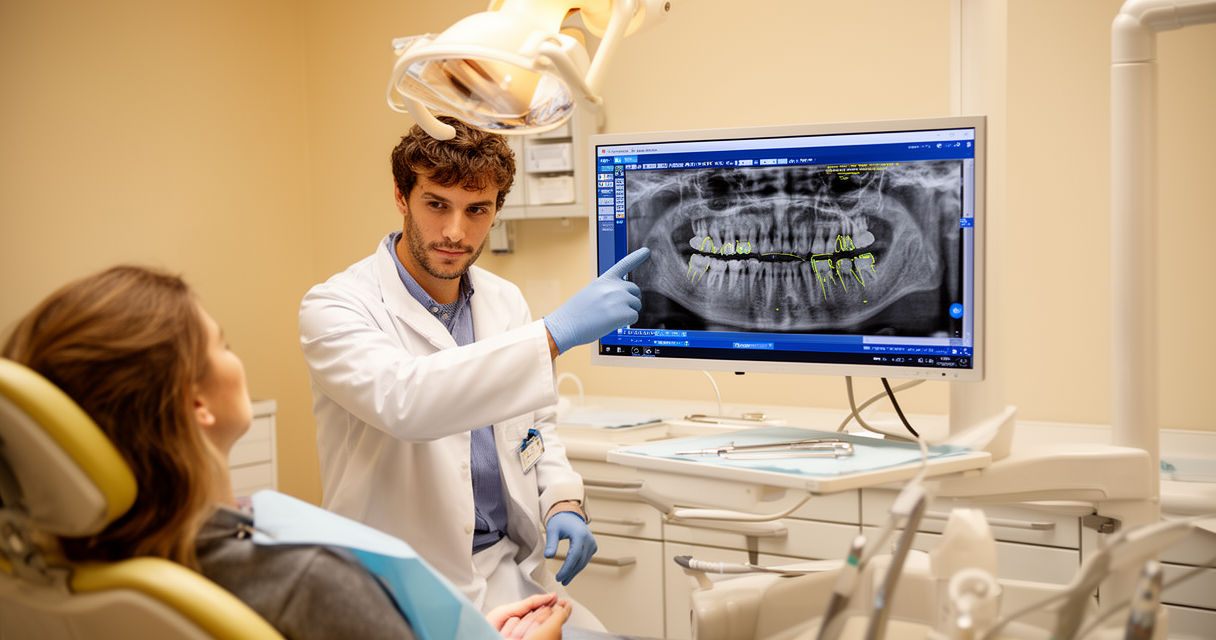
Pearl’s Second Opinion product runs detection models against X-rays and is built around a chairside pitch: show the patient the AI-flagged finding on screen, in the room, during the exam.
FDA FACT: Pearl’s Second Opinion holds 510(k) clearance K210365, cleared March 4, 2022, under regulation 892.2070, covering detection of caries and other dental pathology.
VENDOR CLAIM: Pearl’s marketing references broader capability — panoramic and CBCT support, pediatric-specific detection, and deployment claims spanning roughly 120 countries. None of that is independently verified here. A practice evaluating Pearl should ask which specific modules carry FDA clearance and which are marketed capability outside that scope, verifying per module rather than assuming the whole suite is cleared.
The real-time overlay is Pearl’s strongest practical case for a small practice. Rather than a report generated after the fact, the dentist pulls up the finding live, on the same screen the patient is looking at, during the consult. That’s a genuine workflow difference from a batch-processed report emailed after the appointment.
Pricing: Also unpublished. Pearl AI pricing for dentists is quoted per practice after a sales conversation — no published tier, no self-serve calculator. Any number a practice sees online before talking to sales should be treated as an estimate, not a quote.
Reviews are more mixed here than Overjet’s. A G2 reviewer described the model as “not as well trained as other AI systems,” noted that the color-coding distinguishing anatomy from actual caries findings could be clearer, and flagged slow support response times. A separate G2 reviewer specifically called out false positives on interproximal decay — the AI flagging decay between teeth that wasn’t actually present. That complaint is worth sitting with: it’s a direct, concrete example of why these tools are built as a second set of eyes, not a final read. A dentist who defers to the overlay without independently checking the film is using the software wrong.
VideaHealth: What It Does, What’s Actually FDA-Cleared, and What It Costs
VideaHealth’s Caries Assist product detects caries on X-rays and is typically marketed alongside charting and workflow tools meant to sit inside a practice’s broader software stack.
FDA FACT: Videa Caries Assist holds 510(k) clearance K213795, cleared April 21, 2022, under regulation 892.2070, for caries detection assistance.
VENDOR CLAIM: VideaHealth’s marketing cites detection-performance figures from its FDA submission — on the order of 43% fewer missed caries and 15% fewer erroneous detections for dentists using the AI. Both numbers come from the company’s own submission data, disclosed via its own press releases — not from an independently conducted or peer-reviewed trial. They should be read as the company’s characterization of its own submission, not as an outside validation of clinical performance, and note that “fewer missed caries” is a detection metric, not a revenue or case-acceptance one.
VideaHealth also markets charting integration as part of its bundle, folding detection output directly into treatment-planning workflows. That’s a real convenience if a practice’s existing charting software is clunky — but it’s also a vendor-stated feature, not something independently benchmarked here.
The bigger question for a 1-2 doctor office is fit, not accuracy. VideaHealth’s marketing language, support structure, and per-chair pricing model lean toward multi-location groups and DSOs — the company’s case studies and sales materials skew that direction. A solo practice evaluating VideaHealth should ask directly whether the support tier and per-chair pricing structure were actually built for a one-location office, or whether a smaller practice will be paying DSO-oriented overhead for a single-chair deployment.
Pricing: Not published. Third-party sources describe a per-chair pricing model, but no specific figure is confirmed by the vendor, and no independent source verifies a number reliable enough to quote here.
Independent commentary on VideaHealth specifically is thinner than on Overjet or Pearl — there’s less substantive discussion on G2 and Capterra to draw from, and what exists leans toward brief star ratings without the kind of detailed, specific complaint or praise found for the other two. That’s worth noting directly: a practice researching VideaHealth will find less real-world texture to work from than with its two competitors.
”Increases Case Acceptance” Is a Sales Metric, Not a Clinical One
Every vendor in this comparison leads with some version of higher case acceptance or revenue lift. None of that is clinical evidence, and none of it should be treated as such.
Case-acceptance percentages come from one of two places: a vendor’s own customer success story, or a third-party blog estimate. VENDOR CLAIM and THIRD-PARTY REPORTED are the only two buckets those numbers ever land in — never FDA FACT. The FDA reviewed detection accuracy for a defined use case; it did not review, and does not vouch for, how a dentist’s revenue changes after adopting the tool.
That distinction matters because case acceptance is downstream of a lot of things that have nothing to do with detection accuracy — how a finding is presented to the patient, how confident the dentist sounds, whether the practice has a financing option ready to offer. A well-designed screen overlay can move a patient to say yes to treatment regardless of whether the underlying detection model is meaningfully better than the dentist’s own read. That’s a legitimate business benefit. It is not proof the software is catching disease a trained clinician would have missed.
The Pearl reviewer who flagged false positives on interproximal decay is a useful reality check here: a tool that over-flags will also drive case-acceptance numbers up, because patients see more “problems” on screen. Higher acceptance in that scenario isn’t evidence of better detection — it could just as easily be evidence of overcalling.
Is AI Dental X-Ray Software Worth It for a 1-2 Doctor Independent Practice?
Is dental AI x-ray software worth it for a solo practice is really two separate questions: does it change clinical outcomes, and does it change practice economics. The honest answer splits.
On the clinical side, no vendor here has published independent trial data proving its software catches meaningfully more disease than an experienced dentist reading the same film. The FDA clearances confirm the software works as a detection aid for its cleared use case — not that it outperforms a clinician, and not that skipping it costs a practice diagnoses it would otherwise catch.
On the economics side, dental AI ROI small practice math depends almost entirely on two unpublished numbers: what the software actually costs this specific practice, and whether the insurance/claims or patient-communication benefit is real for this specific patient mix. Neither number is available before a sales call. A single-location office weighing a subscription against its actual patient volume should treat every published ROI figure as a starting point for negotiation, not a number to plan around — the same discipline that applies to is it worth it for a small independent practice when evaluating any practice-management software sized for a bigger operation than a 1-2 doctor office.
Where the tools most plausibly pay for themselves in a small practice: reducing time spent on insurance documentation (Overjet’s stated strength), or improving in-visit patient communication that shortens the sales conversation for treatment (Pearl’s stated strength). Where they’re least plausibly worth it: as a standalone diagnostic upgrade, priced and sold as if the detection accuracy alone justifies the subscription.
It’s also worth noting this is a different category from clinical reference tools that a practice might already be paying for elsewhere — dental X-ray AI is a detection aid tied to imaging hardware and workflow, not a reference lookup, and the ROI case has to be built on its own terms.
Our Take: Which One We’d Actually Recommend
All three tools are legitimately FDA-cleared for what they’re cleared for: assistive detection, reviewed alongside a licensed dentist’s own read of the film. None of the three has independently published proof it catches more disease than a dentist working alone, and none of the revenue or case-acceptance numbers attached to any of them should be treated as clinical evidence.
For a 1-2 doctor independent practice specifically: Pearl is the easiest to justify if the priority is chairside detection paired with real-time patient communication — showing a finding on screen during the visit is a concrete workflow change, not a vague promise. Overjet is the better fit if insurance and claims friction is the bigger daily pain than detection itself; its payer-facing tooling is the more distinctive part of the product for a small office. VideaHealth makes sense mainly if bundled charting matters and the per-chair pricing genuinely fits a single-location budget — its marketing and support model lean toward multi-location groups, so a solo practice should push hard on that fit question before signing.
Whichever direction a practice leans, the process matters more than the pick: get at least two written quotes, not verbal ranges from a sales call, and ask each vendor for its actual FDA clearance letter and intended-use statement rather than relying on the marketing page’s summary of it. That single document will show exactly what the software is cleared to do — and just as usefully, what it isn’t.
Frequently Asked Questions
Is Pearl or Overjet worth it for a 1-2 doctor practice (not a DSO)?
Both are legitimately FDA-cleared detection aids, so “worth it” depends on the specific pain point. Pearl’s chairside overlay suits practices focused on patient communication during exams; Overjet’s claims tooling suits practices where insurance friction eats more staff time than detection accuracy does. Neither has published independent data proving superior clinical outcomes for a small office.
How much does dental AI X-ray software realistically cost?
None of the three vendors publish pricing. Third-party estimates for Overjet alone conflict sharply — one source cites $250-500/month, another $1,000-2,000/month for similar practice sizes — which shows those figures aren’t reliable. Any real number requires a written quote directly from the vendor for the specific practice.
Is dental diagnostic AI FDA-cleared, and what does the clearance actually cover vs marketing?
Yes — Overjet, Pearl, and VideaHealth each hold verified 510(k) clearances for detection-assistance use (K210187, K222746, K210365, K213795). The clearance covers the software as an aid reviewed alongside a dentist’s own read. It does not cover, and the FDA did not evaluate, any case-acceptance or revenue claim marketed on top of it.
Does the AI catch more disease than a dentist reading the film alone, or mainly boost case acceptance/revenue?
No vendor here has published independent, peer-reviewed data proving its software catches more disease than an experienced dentist alone. A December 2025 peer-reviewed narrative review found many FDA-cleared dental imaging AI platforms lack independent clinical validation. Case-acceptance and revenue figures come from vendor case studies, not clinical trials.
Which tool works with existing sensors/imaging software without a full switch?
All three vendors state broad compatibility with common dental imaging systems and sensors, but exact integration depends on the practice’s specific software. Vendor claims of compatibility should be verified against the practice’s actual imaging setup before signing — ask for a list of confirmed integrations, not a general compatibility statement.
The Real Test Before Signing
Overjet, Pearl, and VideaHealth all cleared a real, verifiable regulatory bar — that part isn’t marketing spin. What none of them has cleared is the much higher bar of proving, independently, that the software sees something a trained dentist would have missed, or that the revenue numbers on the sales deck will show up in a specific practice’s books.
A 1-2 doctor office doesn’t need to reject AI detection software to be skeptical of it. It needs a written FDA clearance letter, two competing quotes, and a clear-eyed read of which vendor solves its actual bottleneck — detection, claims, or charting — rather than the one with the most persuasive case study. The AI can flag what you might have glanced past — it can’t yet prove it sees more than you do, and no vendor slide deck changes that.