Is DermaSensor worth it for primary care practices in 2026? The short answer: the clinical case is genuinely strong, but the financial case is not — and the sales conversation usually only covers the first one.
DermaSensor scans a mole in seconds and tells a family doctor “monitor” or “investigate.” The pivotal-trial data behind that claim is genuinely strong, which is exactly why the sales conversation skips past the two questions that actually decide whether the device is worth buying.
A thin-margin practice without an in-house dermatologist cannot add a subscription on the strength of a press release. It needs the real monthly cost, a read on whether its payer mix will reimburse the visit, and a sense of whether the accuracy gain beats training a nurse practitioner on a $500 dermatoscope.
The evidence is legitimate. In DermaSensor’s FDA pivotal trial, the device hit 95.5% sensitivity versus 83% for unaided primary care physicians. A separate real-world study found device-aided PCPs correctly referred 91.4% of cancers, up from 82.0% without it. But DermaSensor publishes no standard price — only promotional rates — and reimbursement runs through unlisted CPT codes that some payers treat as “experimental/investigational.”
For a high-volume practice with poor dermatology access, that is a reasonable bet. For a low-volume practice with a fast referral relationship, the coverage gap is the real cost, not the subscription fee.
What follows is what the studies show, what DermaSensor costs once the promotion ends, and why the CPT question matters more than the accuracy number.
What DermaSensor Actually Is (and Isn’t)
DermaSensor received FDA authorization through the De Novo pathway in January 2024 — the first AI-enabled skin-cancer risk-assessment device cleared for use in primary care. That is a meaningful regulatory milestone, and it is worth stating plainly before anything else: this is not a rubber-stamped wellness gadget.
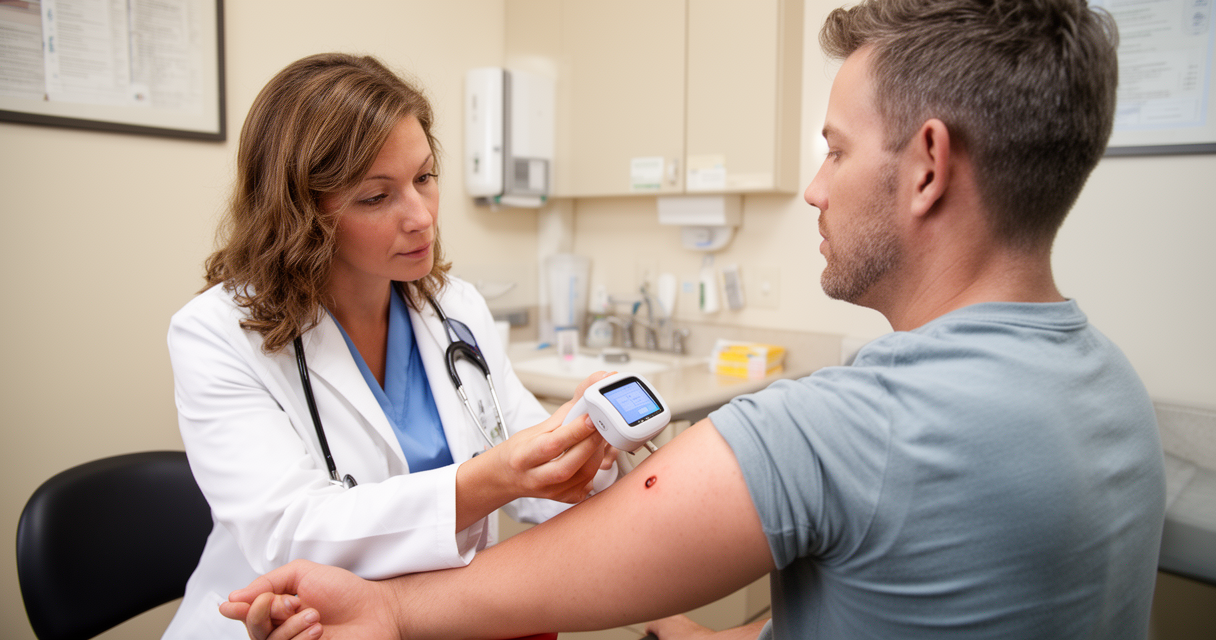
It is also not a camera. DermaSensor uses elastic-scattering spectroscopy (ESS) — a handheld probe that shines light into a lesion and analyzes the scattered wavelengths — with a machine-learning algorithm layered on top to score the result. That distinguishes it from imaging-based skin-cancer tools and from clinical decision support tools like UpToDate and DynaMed, which surface reference knowledge rather than run a physical sensor against tissue. DermaSensor is a device, not a reference lookup, and it belongs in a different evaluation category entirely.
The FDA authorization is specific and narrow. DermaSensor is cleared as an adjunctive tool for clinicians who are not dermatology-trained, to help decide whether a lesion already flagged as suspicious warrants referral. It is indicated for patients 40 and older. It is not authorized for standalone diagnosis, and it does not confirm a diagnosis on its own — a biopsy and pathology read still do that work.
That distinction matters more than it sounds like it should. Any sales conversation that blurs “risk-assessment aid” into “AI diagnosis” is worth pushing back on hard. The device tells a clinician whether to worry more or worry less about a lesion they already noticed. It does not replace the clinician’s eye, and it does not replace a dermatologist.
The Accuracy Data: What the Validation Studies Actually Show
DermaSensor’s marketing leans on a single headline number, but the actual evidence base has at least two distinct studies with two different results — and conflating them into one “accuracy” figure is exactly how a buyer ends up surprised later.
The device’s pivotal trial, DERM-SUCCESS, ran across 22 centers and evaluated 1,579 lesions in 1,005 patients. Published in npj Digital Medicine, it reported:
- 95.5% sensitivity for the device versus 83% for unaided primary care physicians
- 96.6% negative predictive value — a strong number for ruling lesions out
- 20.7% specificity — low, and the figure vendors rarely lead with
Sensitivity varied by cancer type in that same trial: melanoma 90.2%, basal cell carcinoma 97.8%, squamous cell carcinoma 97.7%, per npj Digital Medicine and reporting by Medscape.
A separate, independent comparative study published in the Journal of the American Board of Family Medicine (JABFM) — smaller, with three primary care physicians evaluating 178 lesions across 155 patients — found 90% sensitivity and 60.7% specificity. That is a materially different specificity number from the pivotal trial’s 20.7%, and it is a useful reminder that “DermaSensor’s accuracy” is not one fixed figure. It depends on which study, which population, and which clinicians are being measured.
Real-world referral behavior showed genuine improvement in a study reported by Patient Care Online: device-aided PCPs correctly referred 91.4% of cancers versus 82.0% without the device, diagnostic sensitivity rose from 71.1% to 81.7%, and clinician management confidence climbed from 36.8% to 53.4%.
That low specificity in the pivotal trial — 20.7% — is the number worth sitting with. Low specificity means a higher false-positive rate. In practice, that translates to more “investigate” flags on lesions that turn out benign, which means more unnecessary referrals and more biopsies than the sensitivity headline alone suggests. That is the actual tradeoff being purchased: fewer missed cancers, at the cost of more downstream workups on lesions that were never dangerous. Any practice evaluating the device should model that cost, not just the catch-rate benefit.
What DermaSensor Actually Costs a Primary Care Practice
DermaSensor does not publish a standard list price. The device is sold on a subscription-only model, quoted per practice, with no publicly posted rate card.
The only figures available publicly are promotional, not standard pricing: DermaSensor’s own Skin Cancer Awareness Month materials and FAQ page have reported rates around $199 a month for a capped scan volume and $399 a month for unlimited use, alongside periodic zero-setup-fee campaigns. Those numbers should be treated as promotional snapshots, not a durable price — there is no indication either figure is the post-promotion standard rate, and no dollar figure should be assumed to hold once a campaign ends.
There is no hardware purchase involved. The device itself remains DermaSensor’s property throughout the subscription and gets returned to the company if the practice cancels. The contract carries a 90-day minimum commitment, with no restocking fee once that window has passed.
A subscription-only model with no published standard price is a pattern worth treating with some skepticism in medtech sales generally — it shifts pricing leverage entirely to the vendor’s sales team, and a promotional rate quoted in a first call is not the number that shows up on an invoice in month four. Any practice seriously evaluating DermaSensor should get the post-promotional monthly rate in writing before signing anything, not just the discounted headline number used to close the deal.
The Reimbursement Problem: CPT 96999/17999 and the “Experimental” Language
This is the section that matters most, and it is the section vendor pitches spend the least time on.
DermaSensor scans are typically billed under one of two unlisted CPT codes: 96999 (unlisted special dermatological service or procedure) or 17999 (unlisted procedure, skin and subcutaneous tissue). Unlisted codes exist precisely because no specific CPT code has been created for the service — and that has direct financial consequences.
Unlisted codes carry no set Medicare fee. Each claim gets reviewed case-by-case by the Medicare Administrative Contractor (MAC), and commercial payers are free to deny the claim outright or classify the service as “experimental/investigational” — a label that, once applied, tends to stick across future claims from the same payer.
General billing guidance on unlisted codes — not specific to DermaSensor, but directly applicable to how a claim like this gets processed — is blunt about the burden this puts on the billing staff. As one commenter on r/CodingandBilling put it, discussing unlisted-code billing broadly: “Unlisted codes are valued at $0 so you have to tell them what it’s worth and why.” Another commenter on the same subreddit, again speaking generally about unlisted-code claims rather than DermaSensor specifically, described the practical reality: “Unlisted codes raise more flags and will pretty much always get denied and will need medical records to appeal for medical necessity.”
That is the same payer-by-payer reimbursement uncertainty driving AI prior authorization denials in other corners of AI-enabled medicine — a new technology outrunning the billing infrastructure built to pay for it, leaving front-office staff to make the case claim by claim.
DermaSensor does offer free reimbursement guidance through a partner called The Reimbursement Group (TRG). That is real mitigation and worth using — but it is guidance, not a payment guarantee. A separate analysis of DermaSensor’s public financial filings made the uncertainty explicit: “Adoption depends on physician acceptance and reimbursement pathways, which remain uncertain… Only one year of financials is disclosed,” per an SEC-filing analysis circulated on r/JoinOwntric.
The practical takeaway for a small practice: budget the first year assuming zero reimbursement, and treat any payer approval that comes through as upside rather than the baseline case. Practices that budget the other way around tend to discover the gap on their first denied claim.
DermaSensor vs. the Alternatives: 3DermSpot, DermoSight, and Just Training on Dermoscopy
DermaSensor is not the only AI-adjacent skin-cancer tool on the market, and it is not the only option for a practice trying to close a dermatology-access gap.
3DermSpot received FDA Breakthrough Device Designation in 2020 — the first AI dermatology device to earn that status — and uses an image-based rather than spectroscopy-based approach. As of 2026, there is limited public information on its US commercial availability or pricing, which makes it harder to evaluate as a near-term alternative rather than a device still working through commercialization.
DermoSight, from DeepX Diagnostics, is FDA-cleared for teledermatology screening and has seen real deployment in the UK and Europe, including partnerships with the NHS and Boots. Its “Optical Transfer Diagnosis” AI layer, however, is not yet FDA-approved for diagnostic use in the US. It is worth watching, but it is not yet a like-for-like US alternative to DermaSensor today.
The lower-tech option is training staff on a standard dermatoscope. That gap is larger than most practices assume: only about 16% of primary care clinics have dermatoscope access, roughly 9% use one regularly, and about 15% of clinicians report being trained on one, according to a scoping review cited in the JABFM comparative study. Structured dermoscopy training has shown measurable accuracy and cost-effectiveness gains where it has been implemented — and it results in owned equipment rather than a recurring subscription.
This adoption pattern is not unique to dermatology. It mirrors how AI diagnostic devices are already being adopted in dental practices, where imaging-AI tools have moved faster into routine use than reimbursement policy has kept pace with — the clinical case arrives well before the billing infrastructure does.
| Regulatory status | US commercial availability | Cost model | Who it fits | |
|---|---|---|---|---|
| DermaSensor | FDA De Novo, Jan 2024 (adjunctive risk-assessment) | Available now, US | Subscription, no published standard rate | High lesion volume, poor derm access |
| 3DermSpot | FDA Breakthrough Device Designation, 2020 | Limited public data as of 2026 | Not publicly disclosed | Watch, not yet buy |
| DermoSight | FDA-cleared for teledermatology screening; AI layer not yet FDA-approved for US diagnostic use | Deployed in UK/Europe (NHS, Boots) | Not applicable to US market yet | Not a current US option |
| Dermatoscope + training | Standard equipment, no AI clearance needed | Available now, US | One-time purchase (about $500) plus training time | Practices with decent local derm access already |
For a practice with reasonable local derm access, training one clinician on a dermatoscope is the cheaper, ownership-based alternative. DermaSensor earns its subscription fee mainly where referral access is genuinely scarce — rural practices, areas with long dermatology wait times, or clinics seeing a high volume of suspicious lesions relative to their referral capacity.
Our Take: Which Primary Care Practices Should Buy DermaSensor
Two things are true at once here, and the DermaSensor sales pitch tends to collapse them into one. The device is a well-validated diagnostic aid. It also comes with a coverage gap that most practices will discover for themselves on their first denied claim, rather than hear about from the sales team upfront.
Buy it if the practice sees a high volume of suspicious lesions, has genuinely poor local dermatology access — long wait times, no nearby specialist, a rural service area — and can absorb six to twelve months of subscription cost without counting on reimbursement to make the math work.
Skip it if lesion volume is low, the practice already has a fast referral relationship with a dermatologist, or the practice cannot tolerate the cash-flow hit of a denied first claim while the reimbursement question gets sorted out.
For everyone in between, three concrete steps matter more than the accuracy numbers: negotiate the post-promotional rate in writing before signing, use DermaSensor’s reimbursement-support program aggressively rather than passively, and track the actual denial rate on submitted claims for a full quarter before deciding whether to renew.
The evidence supports the device as a genuine clinical tool. It does not support the vendor framing that validation and reimbursement are the same conversation. A practice can accept the first claim — the accuracy is real — without accepting the second, unstated one: that a payer will pay for it just because the FDA cleared it. Those are two separate risks, and only one of them has been de-risked so far. This is exactly the kind of category a practice should evaluate alongside the broader landscape of best AI clinical decision support tools for 2026 — not in isolation, and not on the strength of a sales deck alone.
Frequently Asked Questions
How much does DermaSensor actually cost a primary care practice per month?
There is no standard published rate. Only promotional pricing has been publicly reported — around $199 a month for capped volume or $399 a month for unlimited use, plus periodic zero-setup campaigns. Practices should get the post-promotional rate in writing before signing, since promotional pricing is not guaranteed to hold past the introductory period.
Will insurance reimburse DermaSensor scans?
It is genuinely uncertain and depends on the payer. Scans are typically billed under unlisted CPT code 96999 or 17999, which carry no fixed Medicare rate and get reviewed case-by-case. Some payers treat the service as experimental/investigational. DermaSensor’s free reimbursement support program can help build the case, but it is guidance, not a guarantee of payment.
How accurate is DermaSensor compared to a dermatologist or dermoscopy?
DermaSensor’s FDA pivotal trial found 95.5% sensitivity versus 83% for unaided primary care physicians, but specificity in that same trial was low at 20.7%, meaning a meaningful false-positive rate. A separate, smaller comparative study found 90% sensitivity and 60.7% specificity. It functions as an adjunctive second read, not a replacement for dermatologist-level judgment.
Does DermaSensor replace the need to refer patients to a dermatologist?
No. It is designed as an adjunctive tool to help a clinician who is not dermatology-trained decide whether and when to refer a patient. It is not authorized for standalone diagnosis and does not confirm a diagnosis on its own.
What are the real alternatives to DermaSensor?
3DermSpot has FDA Breakthrough Device Designation but limited public US commercial data as of 2026. DermoSight is FDA-cleared for teledermatology screening but mainly deployed in Europe, with its AI diagnostic layer not yet FDA-approved for US use. The lowest-tech alternative is training a clinician on a standard dermatoscope — equipment only about 16% of primary care clinics currently have.
The Bottom Line on DermaSensor in 2026
DermaSensor’s clinical validation is real and worth taking seriously. The risk sitting between a practice and a return on that investment is not the algorithm — it is the unlisted CPT code standing between the scan and getting paid for it.
Before signing anything, get DermaSensor’s exact post-promotional monthly rate in writing, and call the practice’s top three payers directly to ask how they have historically handled claims under CPT 96999 or 17999. The vendor’s reimbursement team should not be the only data point in that decision.
A device that is 95% sensitive but 0% reimbursed on the first claim is not a diagnostic upgrade. It is an unbudgeted expense wearing a lab coat.
References
- FDA De Novo authorization DEN230008 (Jan 2024) / npj Digital Medicine, DERM-SUCCESS pivotal trial results
- npj Digital Medicine — DERM-SUCCESS pivotal trial sensitivity/specificity/NPV data
- Medscape — reporting on DermaSensor sensitivity by lesion type
- Journal of the American Board of Family Medicine (JABFM), independent comparative study, via Medical Economics
- Patient Care Online — real-world referral and diagnostic confidence data
- PMC-cited scoping review on primary care dermatoscope access and training rates
- DermaSensor official FAQ — subscription terms, minimum commitment, reimbursement support program
- DermaSensor Skin Cancer Awareness Month promotional pricing page
- mdclarity.com — CPT 96999/17999 unlisted-code billing reference
- carepatron.com — CPT 96999/17999 unlisted-code billing reference
- Refresh Miami — DermaSensor funding and adoption context
- ScienceDirect — AI dermatology device review, 3DermSpot Breakthrough Device Designation
- PR Newswire — DermoSight (DeepX Diagnostics) FDA clearance and European deployment
- r/CodingandBilling — general unlisted-code billing discussion (not DermaSensor-specific)
- r/JoinOwntric — SEC-filing analysis of DermaSensor financials and reimbursement risk