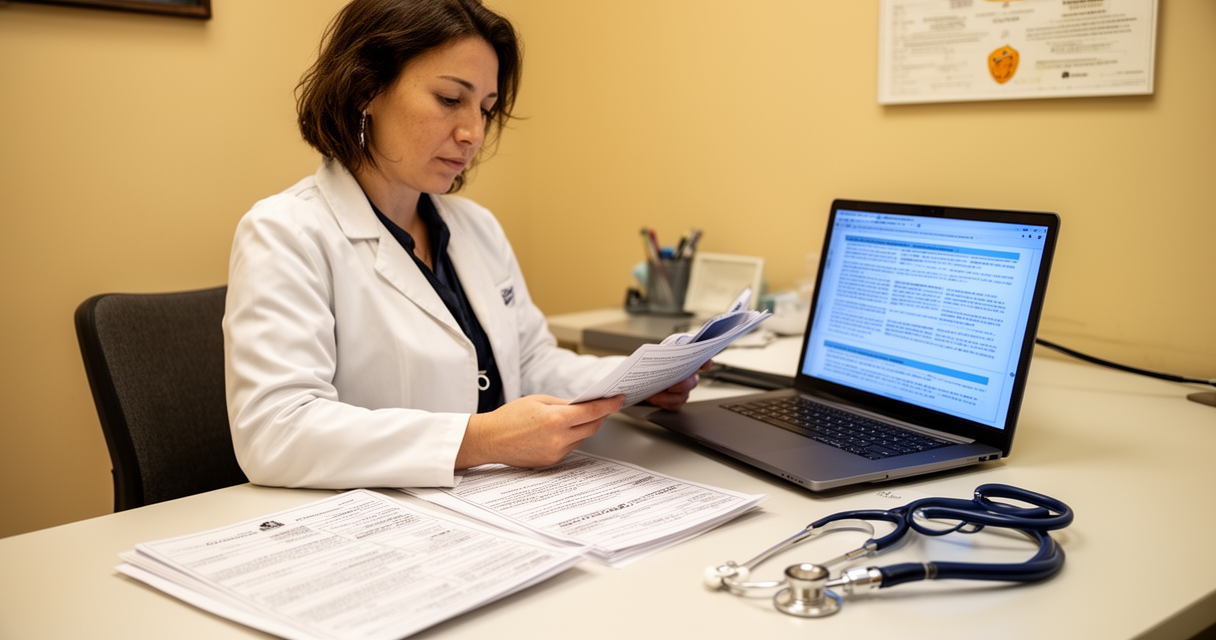
A new referral shows up, and before the visit even starts, a clinician is scrolling through 40 pages of outside records, three different portals, and a fax nobody filed — trying to reconstruct a chart the EHR should already understand.
That unpaid pre-visit labor is exactly what AI pre-charting software vendors are chasing. The problem is that most of the loudest names in this space — Notable, Innovaccer — are built and priced for health systems, not the solo internist or five-physician group actually drowning in outside records.
Quick answer: for independent and small practices, three tools are realistically reachable — Navina, Health Note, and Honey Health. Notable and Innovaccer are filtered out here because both sell through enterprise sales motions aimed at hospitals, ACOs, and payers, not single practices. None of the three should be trusted blind on outside-record accuracy — every summary needs a human check before it changes what a clinician does in the room.
The full comparison, the vendor claims worth doubting, and the safety tradeoff nobody’s pricing page mentions follow below.
What Is AI Pre-Charting (and How Is It Different From an AI Scribe)?
Pre-charting AI works before the visit. It ingests outside records, labs, imaging reports, claims data, and prior notes, then produces a chart-ready summary a clinician reviews on the way into the room.
That’s a different job from an AI scribe, which works during the visit — listening to the encounter and drafting the note in real time. Suki, Nuance DAX Copilot, and Abridge fall into that category; how AI scribes compare is a separate evaluation from what follows here, and the two categories get lumped together constantly in vendor marketing.
A third, related category is patient intake — collecting new information directly from the patient before the visit, usually via a form or conversational agent. That’s not pre-charting either, though several vendors (Health Note especially) sell both in one package.
Vendors blur these three categories on purpose, because “AI documentation” sounds like a bigger market than any single piece of it. That blurring is exactly what creates buyer confusion for a small practice trying to solve one specific problem.
The gap pre-charting is built to close is real. One clinician on r/medicine summed it up bluntly: “The biggest problem with all these AI tools is that they don’t have context from the problem list, medications and past notes.” A scribe that transcribes perfectly still can’t tell a physician what happened at the specialist visit three states away last month. Pre-charting targets that specific hole.
That makes it, in principle, the underhyped and genuinely useful corner of healthcare AI — it targets paperwork, not clinical judgment. Underhyped does not mean unverified, though, and the rest of this piece treats it that way.
Why Notable and Innovaccer Are NOT on This List
Both companies are real, well-funded, and capable. Neither is built to be bought by a single independent practice.
Notable sells to health systems through an enterprise motion — no public self-serve pricing exists on its site. Third-party estimates circulating around the industry suggest enterprise-scoped contracts and multi-quarter implementation timelines, but that figure is not confirmed on Notable’s own materials and shouldn’t be repeated as fact.
Innovaccer is enterprise SaaS priced around panel size and modules, with the company publicly moving toward outcomes-based pricing arrangements. Its product is built for population-level risk management across a health system or ACO — not a single practice’s daily chart-prep workflow. Pricing here, too, is qualitative at best from the outside: some third-party estimates exist, but Innovaccer’s own site doesn’t publish numbers, and repeating an unconfirmed dollar figure as fact would be a disservice to anyone trying to budget.
The tell is in the language. If a vendor’s homepage talks about “health systems,” “ACOs,” “value-based contracts,” or requires a multi-quarter implementation before go-live, it isn’t a self-serve product a solo physician or small group can sign up for on a Tuesday afternoon. Most roundups of this category list every well-funded name in the space without checking whether an independent practice can actually buy the thing — that’s the gap this piece is trying to close.
The 3 AI Pre-Charting Tools Built for Independent Practices — Compared
| Tool | What it does | EHR integration | Pricing model | Best for | Key caveat |
|---|---|---|---|---|---|
| Navina | Aggregates EHR data, labs, claims, and unstructured notes into a point-of-care patient profile; strong HCC/risk-adjustment surfacing | Confirmed: Epic, athenahealth. Other EHRs — verify directly with the vendor | Not public; custom, sales-led | Value-based primary care doing risk adjustment | HCC suggestions have been reported inaccurate on Reddit; requires an audit step |
| Health Note | Pre-visit intelligence plus protocol-driven patient intake, generating a pre-visit summary | Described only as “existing EHR systems” — vague, verify the actual list | Not public; sales-led | Urgent care, pediatrics, specialty practices with heavy intake burden | Integration claims are broad and unconfirmed for specific small-practice EHRs |
| Honey Health | Agentic AI that autonomously pulls outside records and results, pre-populating the chart with less custom integration | Works inside the EHR/portal; less deep integration than Navina by design | Not public; sales-led | Independent practices wanting minimal setup | Newest company (founded 2025); “autonomous” pulling means less manual review by default |
None of the three publishes self-serve pricing — a small-practice pain point in itself. A solo physician evaluating a $200/month scribe subscription against a “call sales” pre-charting tool is comparing two completely different buying processes, and that asymmetry is worth flagging before anyone starts a demo cycle.
Deep Dive: Navina
Navina ingests structured EHR data, labs, claims history, and unstructured clinical notes and turns them into a single point-of-care patient profile. Its strongest documented use case is risk adjustment — surfacing Hierarchical Condition Category (HCC) gaps and suspected diagnoses for value-based primary care groups.
EHR integration is publicly confirmed for Epic and athenahealth. Smaller-practice EHR platforms like eClinicalWorks or DrChrono are not listed as confirmed integrations anywhere in Navina’s public materials — that needs a direct check with the vendor before signing, not an assumption based on a sales call.
Navina claims its tool saves clinicians about 9 minutes per visit. That is a vendor claim, self-reported, and not independently verified — it should be treated the same way any vendor efficiency number gets treated: as marketing until proven otherwise.
The independent evidence tells a more complicated story. On r/CodingandBilling, one biller described the tool this way: “Is anyone here familiar with Navina (AI that captures HCCs)?… For me, it makes it harder. There are so many inaccurate diagnoses (specifically billing E66.01 and a code from E66.8xx TOGETHER). I am at my wits end.” That’s not a minor formatting complaint — it’s a coding-accuracy failure with real billing consequences.
Navina is best suited to value-based primary care groups already doing risk-adjustment work, with staff time budgeted specifically to audit HCC suggestions before they go anywhere near a claim. A practice expecting to turn the tool on and trust its output unsupervised is setting itself up for the exact scenario described above.
Deep Dive: Health Note
Health Note positions itself around pre-visit intelligence combined with protocol-driven patient intake, most commonly marketed toward urgent care, pediatrics, and specialty practices where high new-patient volume makes intake the bigger operational bottleneck.
Its EHR integration claim is the vaguest of the three: “existing EHR systems,” with no specific published list. That phrasing should be read as marketing shorthand, not a confirmed integration — any practice evaluating Health Note needs to get its own EHR name in writing before assuming compatibility.
Pricing is not public, following the same sales-led pattern as Navina and Honey Health.
Health Note sits in the middle of this category. It’s not a pure chart-prep tool the way Navina is, and it’s not an autonomous back-office system the way Honey Health is marketing itself. Practices whose real pain point is a messy patient-intake process combined with a pre-visit summary — rather than deep outside-record aggregation — are the better fit here.
Deep Dive: Honey Health
Honey Health takes an agentic approach: the AI autonomously reaches out and pulls outside records and results, then pre-populates the chart with comparatively less custom integration work than a Navina-style deployment requires.
The company explicitly courts independent practices and smaller health systems as its target buyer — a more direct pitch to small practices than either Navina or Health Note makes. It is also the newest of the three, founded in 2025, which means a short public track record and fewer independent data points to evaluate against.
Its marketing claims an 8-12% increase in net collections within 90 days. That number is self-reported by the vendor, drawn from its own case studies, and has no independent verification behind it — it belongs in the same “claim, not fact” bucket as Navina’s time-savings figure.
The bigger structural concern is the “autonomous” design itself. A tool that pulls records and populates a chart with minimal human intervention by default concentrates review responsibility in a different place than a tool built around an explicit review step. That’s a genuine tradeoff, not a feature to accept uncritically — worth returning to in the safety section below.
Is the “Saves 2-4 Hours a Week” Claim Real?
The commonly repeated figures in this space — 8 to 15 minutes saved per visit, 2 to 4 hours saved per week — trace back to vendor blogs and case studies, not independent, peer-reviewed pre-charting research. No such study currently exists for pre-charting specifically.
The closest rigorous independent data point comes from a different but adjacent category: AI scribes, not pre-charting. A study published in JAMA in April 2026, covering roughly 1,800 clinicians across five academic medical centers and reported by STAT News, found AI scribe use associated with about 13.4 fewer minutes of daily EHR time, about 16.0 fewer minutes of daily documentation time, and roughly 0.49 additional weekly visits per clinician.
Those numbers are meaningfully more modest than “2-4 hours a week,” and they measure scribes — real-time documentation during the visit — not pre-visit chart preparation. It’s the best available rigorous benchmark for AI-assisted clinical documentation broadly, and it should function as a reality check on pre-charting’s unverified numbers rather than as direct proof of them.
Community sentiment splits along predictable lines. A skeptic on r/healthIT put it sharply: “You can trace back through all of the vendor claims about enhanced productivity, ROI, provider QOL and see they were just blowing smoke to make a buck… Choose wisely.” Elsewhere on the same subreddit, a more positive account exists too: “One of our doctors… is saving 2-3 hours of dictation/EMR time a week.” Both are anecdotal, and both should be weighted the same way — as data points, not proof.
The practical takeaway: treat every pre-charting vendor’s time-savings number as a claim to test in a pilot, not a statistic to plan a budget around.
The Safety and Liability Angle Nobody’s Vendor Page Mentions
A pre-charting summary that misreads or drops something from an outside record doesn’t just create extra work — it changes what a clinician believes they know before walking into the room. That’s a materially different risk than a scribe-drafted note, which the clinician still reads and edits before signing.
The Navina HCC example from earlier isn’t a hypothetical — it’s the concrete case. Billing two contradictory codes together (E66.01 and an E66.8xx code) isn’t a cosmetic error; it’s the kind of mistake that creates downstream audit exposure and rework. A reply in the same r/CodingandBilling thread made the stakes explicit: “accuracy matters way more than volume. A wrong HCC suggestion creates more work and stress for everyone downstream.”
The liability question extends past coding into clinical judgment itself. As one physician on r/medicine put it: “I find AI to be fairly worthless because we bear 100% liability for whatever is in our note… generally helpful, aggressively detailed, wrong often enough that I can’t trust any of them.” That’s the core tension of this entire category — the clinician signs the note, not the vendor.
The mitigation is simple and non-negotiable: an AI pre-chart summary is never a substitute for opening the source record on anything that changes management — a new diagnosis, a medication change, an abnormal critical result. Treat the summary as a first draft, not a verified fact set. Practices that skip this step aren’t saving time; they’re borrowing risk against a future chart review.
Our Take: Who Should Actually Use Which Tool
For a value-based primary care group doing active risk-adjustment work and able to absorb a sales cycle, Navina is the pick — with staff time explicitly budgeted to audit HCC suggestions before they touch a claim, not as an afterthought.
For a practice whose bigger operational gap is messy intake plus a usable pre-visit summary — urgent care, pediatrics, or any specialty with high new-patient volume — Health Note fits better than a pure chart-prep tool.
For a true independent or solo practice wanting minimal setup overhead and comfortable being an early adopter of a newer company, Honey Health is the reasonable choice — provided the “autonomous” pull doesn’t translate into skipping manual review. Turning off the review step to save time defeats the entire safety argument above.
For any independent or small practice currently being pitched Notable or Innovaccer, the honest read is that the vendor mis-scoped the deal. Either walk away or push explicitly for a right-sized, practice-level version of the product rather than the enterprise package built for a health system’s population-health team.
The broader point stands regardless of which tool gets chosen: pre-charting is genuinely one of the better applications of AI in healthcare right now, because it targets paperwork rather than diagnosis. That’s a real advantage over most of the AI hype cycle in this industry. But being a good category doesn’t mean the vendor’s time-savings number should be trusted at face value, and it doesn’t mean the summary gets to replace opening the actual chart.
Frequently Asked Questions
What’s the difference between AI pre-charting and an AI medical scribe?
Pre-charting works before the visit, pulling outside records, labs, and prior notes into a summary a clinician reviews before walking in. An AI scribe works during the visit, listening to the encounter and drafting the note in real time. They solve different problems and are frequently sold together, which is part of why buyers get confused between them — see how AI scribes compare, including Suki vs. Nuance DAX Copilot, for the scribe-specific evaluation.
Which EHRs do these pre-charting tools actually integrate with?
Navina publicly confirms Epic and athenahealth integrations. Health Note describes only “existing EHR systems” without a specific list. Honey Health emphasizes working inside the EHR or patient portal with lighter integration by design. None of the three has a publicly confirmed integration with eClinicalWorks or DrChrono — practices on smaller EHR platforms, including those weighing whether athenahealth is worth it for small practices, need to verify compatibility directly with the vendor before signing anything.
Is the “8-15 minutes per visit” or “2-4 hours per week” time-savings claim real?
Those figures are vendor-sourced and not independently verified for pre-charting specifically. The closest rigorous independent data comes from a JAMA study (April 2026, reported by STAT News) covering AI scribes — a different, adjacent category — which found more modest gains: about 13.4 fewer minutes of daily EHR time and 16.0 fewer minutes of documentation time. No equivalent peer-reviewed study exists for pre-charting alone.
Is AI pre-charting worth it for a solo or small practice, or only at health-system scale?
The category itself is worth evaluating — it targets real administrative burden. But Notable and Innovaccer are built and priced for health systems and shouldn’t be on a small practice’s shortlist. Navina, Health Note, and Honey Health are reachable for independent practices, though none publishes self-serve pricing, so every deal still runs through a sales conversation.
Who’s liable if the AI pre-charting summary gets something wrong?
The clinician who signs the note carries full liability, regardless of which AI tool produced the summary. That’s why every summary from these tools should be treated as a first draft to verify against the source record — not a finalized fact set — especially on anything that would change a diagnosis, medication, or treatment plan.
The Bottom Line
For independent and small practices, the realistic shortlist is Navina, Health Note, and Honey Health — not Notable or Innovaccer, both of which are scoped and priced for health systems. Among the three, the right pick depends on whether the bigger pain is risk-adjustment coding, patient intake, or minimal-setup chart prep, and every one of them requires a human to verify the summary before it changes clinical decisions. For related admin-burden tools worth the same scrutiny, see AI clinical decision support tools for physicians, UpToDate vs. DynaMed, and best AI prior authorization software for small practices.
The AI that reads your patient’s chart before you walk in the room should make you faster — it should never make you more confident than the evidence deserves.